
























There is a thought-provoking reality after years of working with developers across various levels: Many study incredibly hard. They grind through frameworks, databases, caches, queues, cloud technologies, and even AI. They code every day, purchase courses, and watch videos relentlessly.
Yet, after 3, 5, or even 7 years in the industry, many still find themselves trapped in a sense of ambiguity: they know a lot of things, but they do not truly understand the system. They can comfortably complete assigned tasks, write APIs, or fix bugs regularly. However, the moment they touch upon architecture, scalability, reliability, or production incidents, they instantly lose their confidence.
They are not lazy. They are not standing still. But in today’s AI era, they might just be moving in the wrong direction.
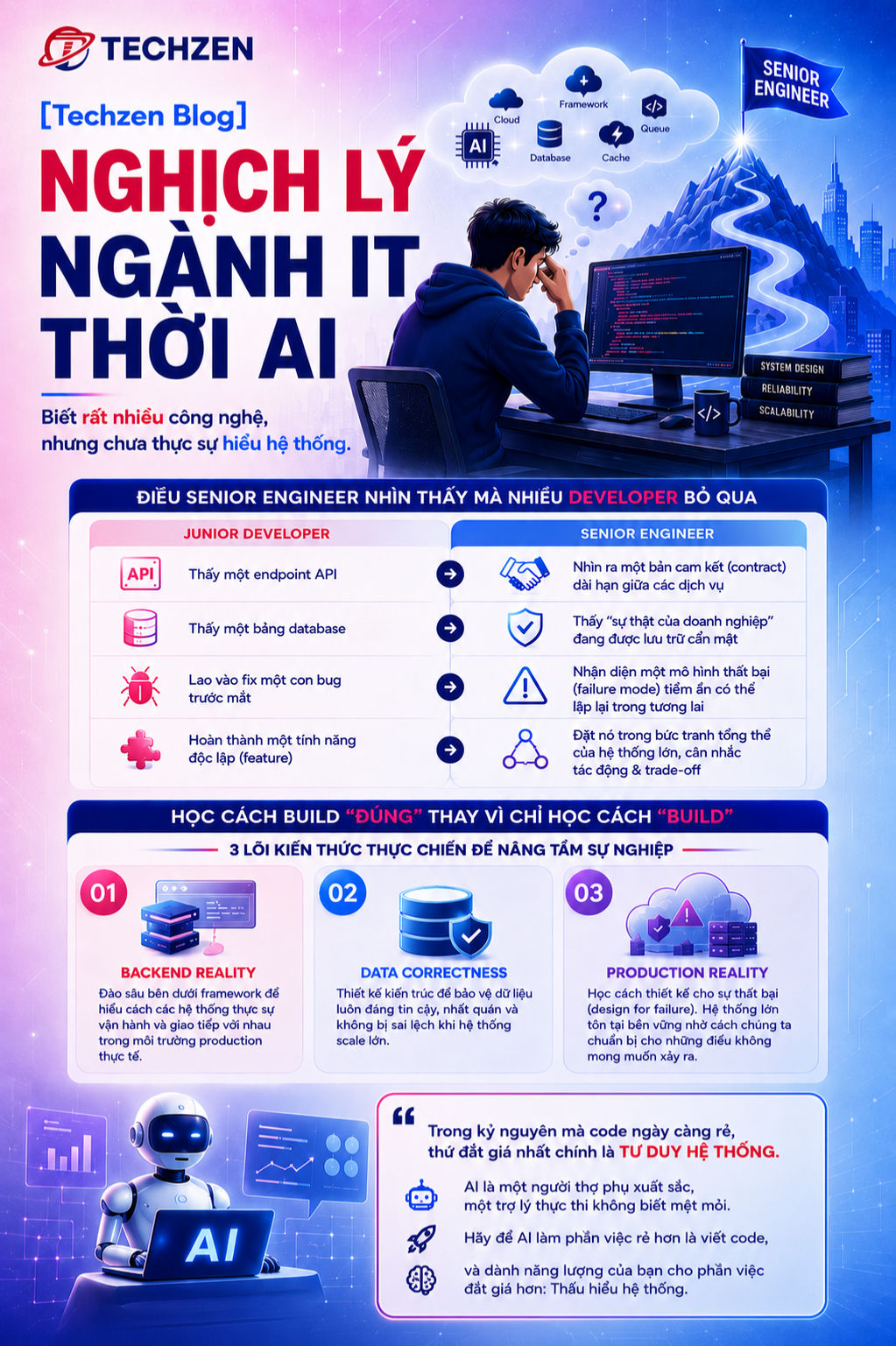
What Senior Engineers See That Many Developers Overlook
Many still mistakenly believe that a Senior Engineer is simply someone who has studied more, knows more frameworks, or has stacked more projects into their CV. In reality, the boundary between a Junior and a Senior is not determined by the volume of knowledge, but by the depth of their worldview.
When facing the exact same piece of code, the same problem, or the same product, their perspectives are entirely worlds apart:
- Where a Junior only sees an API endpoint, a Senior recognizes a long-term contract between services.
- Where a Junior sees a soulless database table, a Senior sees the “single source of truth” of the business being securely stored.
- When an incident occurs, a Junior rushes to fix the immediate bug, while a Senior calmly identifies a potential failure mode that could repeat in the future.
- And while a Junior excitedly delivers an isolated feature, a Senior always places it within the grand blueprint of an entire system, considering cascading impacts and operational trade-offs.
Learning How to Build “RIGHT” Instead of Just Learning How to “BUILD”
To avoid being left behind by the AI wave, shifting from a “how to build” mindset to a “how to build IT RIGHT” approach has become a mandatory requirement for anyone looking to level up their career. This understanding typically revolves around three core areas of real-world expertise:
- Backend Reality: Digging deep beneath the framework to understand how backend systems actually operate and communicate with each other in a real production environment.
- Data Correctness: Knowing how to design architecture that protects business data, ensuring it remains reliable, consistent, and uncorrupted as the system scales.
- Production Reality: Learning how to design for failure. Large-scale systems do not survive on the “happy path” (ideal scenarios); they endure because of how well we prepare for the unexpected.
In an era where code is becoming increasingly cheap, the most expensive asset is system thinking. AI is an excellent apprentice—an tireless execution assistant. Let AI handle the cheaper task of writing code, and save your energy for the more valuable endeavor: understanding the system.
Ultimately, what defines an exceptional software engineer has never been how fast we type, but how deeply we understand the system we build.